I went to the wonderful Vitra Design Museum today to see the equally wonderful Charles and Ray Eames exhibition. The Vitra Campus is a splendid park of architecture by some of the world’s best contemporary architects. There are permanent displays and exhibitions, mostly on designers and, in particular, furniture designers.
The Charles and Ray Eames exhibition, The Power of Design, contains over 500 objects and exhibits, with media that includes “films, photographs, furniture, drawings, sculptures, paintings, textiles, graphic design, models and stage props”. It’s the collection of a life of collaboration and curiosity by “what was arguably the most successful design duo in history”.
It seems, from the completeness of letters the couple wrote to one another, sketches, prototypes, and so on, that the couple kept everything. The result is a curation of personal and professional ephemera that gives remarkable insight into the creative workings of this artistic and romantic liaison. The work spans their partnership from 1940 to 1978 when Charles died.
The breadth and depth of enquiry, their “beginner’s mind“, sense of play and wonderment over time, and curiosity in their world is displayed in this amazing catalogue of their creative output. Much of my reading on serendipity and happy accidents has been more on its occurrence in academia and basic science, than in design or the arts. However, one cannot but help think that this couple must have, by virtue of their interest in so many areas of our world, been blessed with many serendipitous events over the course of their lives. They had solid technical foundations and knowledge, but surrounded themselves with an array of people and objects that spread their interests widely and deeply. The Library of Congress has a collection of over 1000 photographs of the Eameses. Although these pictures are not on display in this exhibition, I think the description of what the photographs contain is worthy of quoting here to give a sense the diversity of what caught their attention and acquaintance:
Images include informal portraits, some possibly created for promotional purposes, and a few for their 1946 Christmas card showing reflection of Charles and Ray in a Christmas ornament. Other persons and events featured: personal vacation trips, including honeymoon trip with Billy and Audrey Wilder to Lake Tahoe, California, and Virginia City, Nevada, trips to Colorado and Arizona, including images of a trading post with Native American crafts; and Lucia Eames and friends, some featuring Christine Meyer dancing. Also includes images created and used to explore design elements–shape, structure, and texture–in nature, objects, and constructions, such as: seaweed and sea gulls at the beach, trees (with close-ups of branches, bark, leaves, and seeds), plants, flowers, human ears and eyes, sculpture, buildings under construction, pilings and piers, stacks of bricks, a wire rat trap and dress form, and constructions by Buckminster Fuller. Many images taken on beach, Santa Monica, California. Also features Eames projects, including images of the future site of Case Study Houses, and models for Case Study House No. 8 (“Bridge” version), Case Study House No. 9, and house for Billy Wilder; Ray’s fabric designs: “Dot Pattern” and “Sea Things;” package and door graphic for Charles’ daughter, Lucia; and a birthday card for John Entenza. Also includes images of proposal and models for the Jefferson National Expansion Memorial competition.
These words neatly capture the overarching feeling of the exhibition for me: Flotsam and jetsam, exquisitely curated, washed up for us all, to allow us to catch a little glimpse of the inner workings of their relationship, work, thoughts and intent.
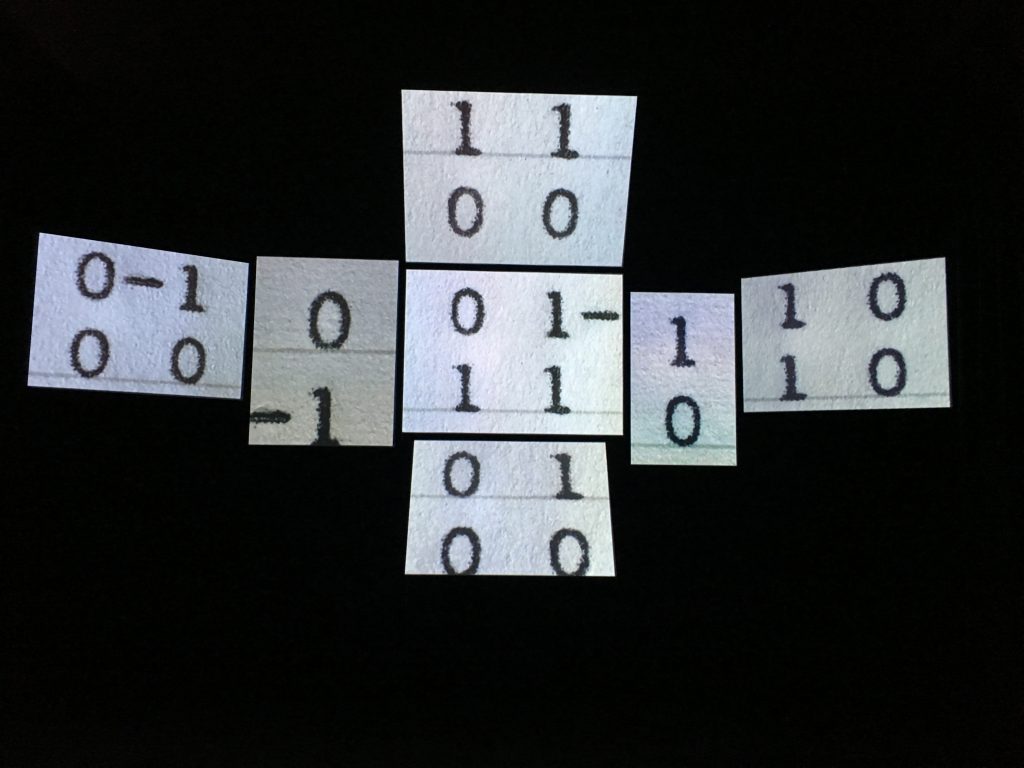
Of interest to me as someone keen on technology, they designed the IBM pavilion at the 1964 World’s Fair. The couple made a short film about IBM at the Fair. The 22 displays seen from about 3:19 mark were recreated at the Vitra Exhibition, so one gets a good sense of how this multi-image collage of film would’ve been watched in 1964. I was struck by just how contemporary both the film content and the multi-screen display are, even over half a century later. There’s some interesting background about this particular display, which was entitled THINK on this blog post. IBM had a strong working relationship with the Eameses. In an article on good design on the IBM website, Charles Eames is quoted as saying “Design is a plan for arranging elements in such a way as best to accomplish a particular purpose.” The IBM text adds to this: “By that definition, IBM’s researchers could be seen as designers, and its designers have been researchers and teachers.” This idea, like the film, is one that feels like a modern idea and one ahead of its time. And yet, pre-Steve Jobs or Jony Ive, here is art influencing IT and vice versa
I took three main things away today:
- If we could develop but a small fraction of the Eames’s curiosity about the changing world in which they lived and worked, we would be well on our way to dealing with the changes Industry 4.0 will create in our lifetimes;
- Take (and keep) notes on everything; and,
- The arts and science belong together.
See it if you get the chance. Buy the catalogue if you don’t. Or, at the very least, watch the Eames’s films on YouTube to get a sense of some of the things that intrigued them. Who knows what you might learn?